Kann die Frau das rabbinische Amt bekleiden?
Can a Woman Hold a Rabbinic Office?
Rabbi Regina Jonas: Ja, Yes, כֵּן !!!

you will find the following information in this text-
- Interaction Guidelines
- Spacial and Visual Detailed Description of the work
- The Story Behind the Sculpture
- Quotes on Flags
- Materials List (detailed)
- Exhibition text and Short Description in English and German
- Works Cited
Interaction Guidelines
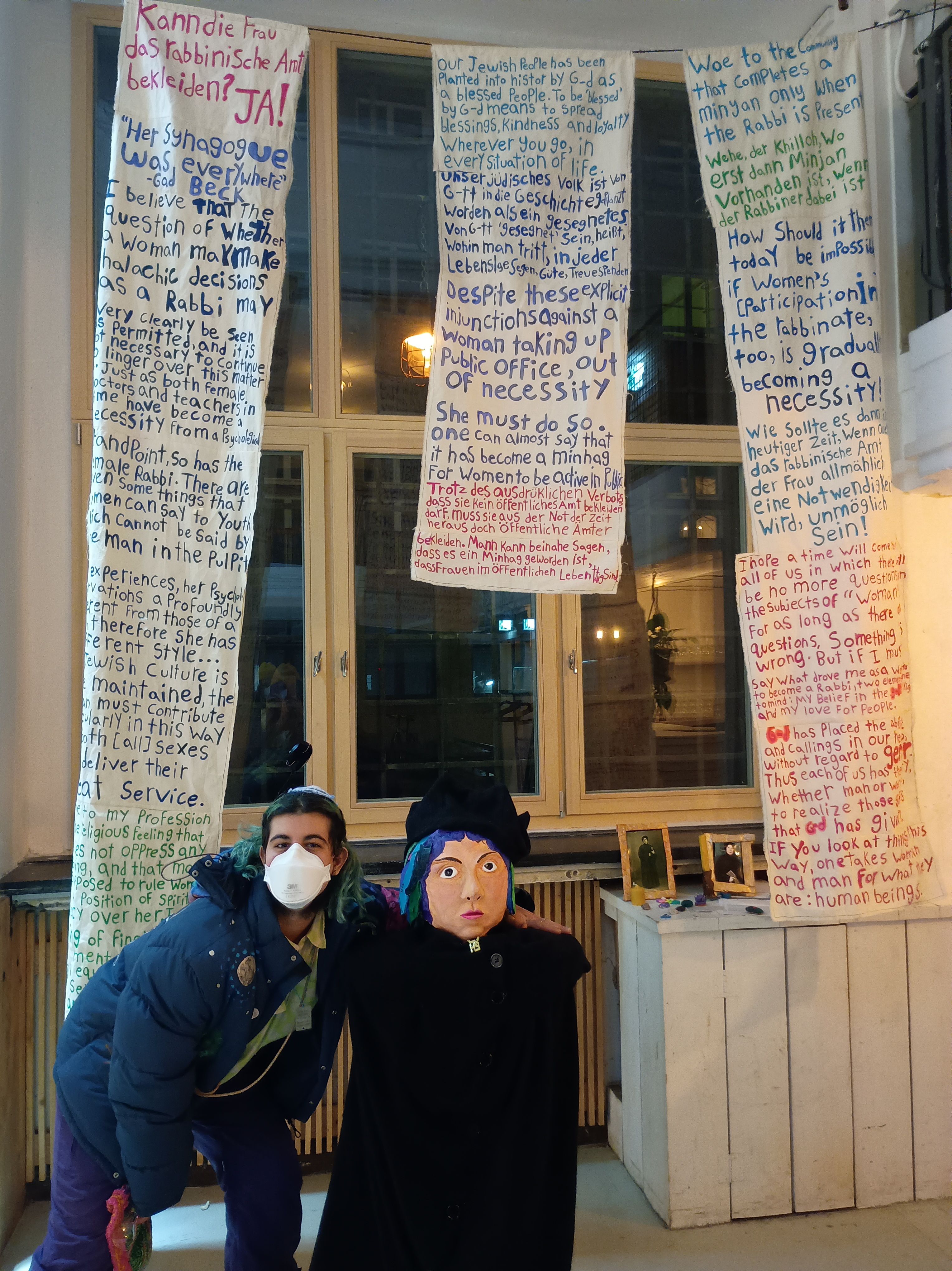
You are welcome to (gently) touch the sculpture*! Play with the fabric, inspect the hat, and feel the buttons on the robe. Trace your fingers over the cardboard hair. I want to give people an opportunity to engage with this work differently than how usual sculpture is exhibited, and for this work to be more accessible. Rabbi Jonas was known to have the synagogue follow her wherever she went, and so in a small way this is also a holy space complete with a place to pray, read her Torah and honor her memory.
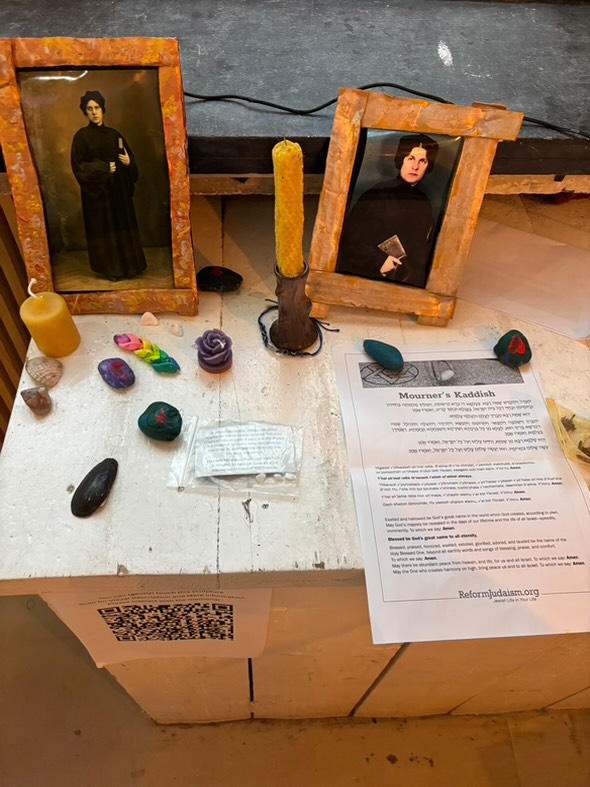
You can place stones, shells, crystals, or something special for the ‘pop-up memorial’/ancestor alter honoring Rabbi Jonas. After the work is deisntalled I will take the items to the Shoah victims’ memorial at the Charlottenburg Jewish Cemetery in the Spring.
*this an exception to the unspoken rules and not a common practice, unless otherwise stated, so DO NOT touch any other works in this exhibit!
Spacial and Visual Detailed Description of the work :
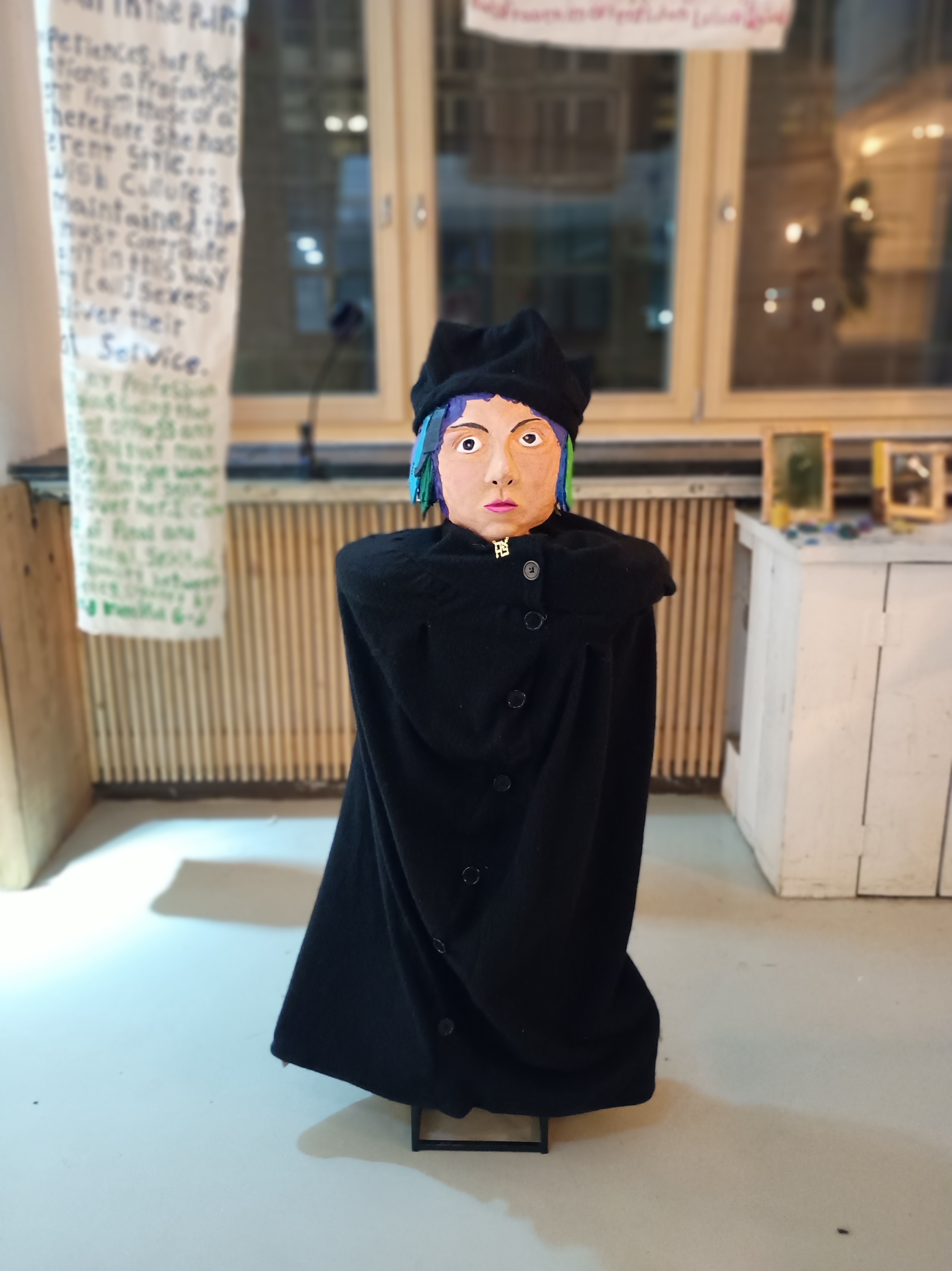
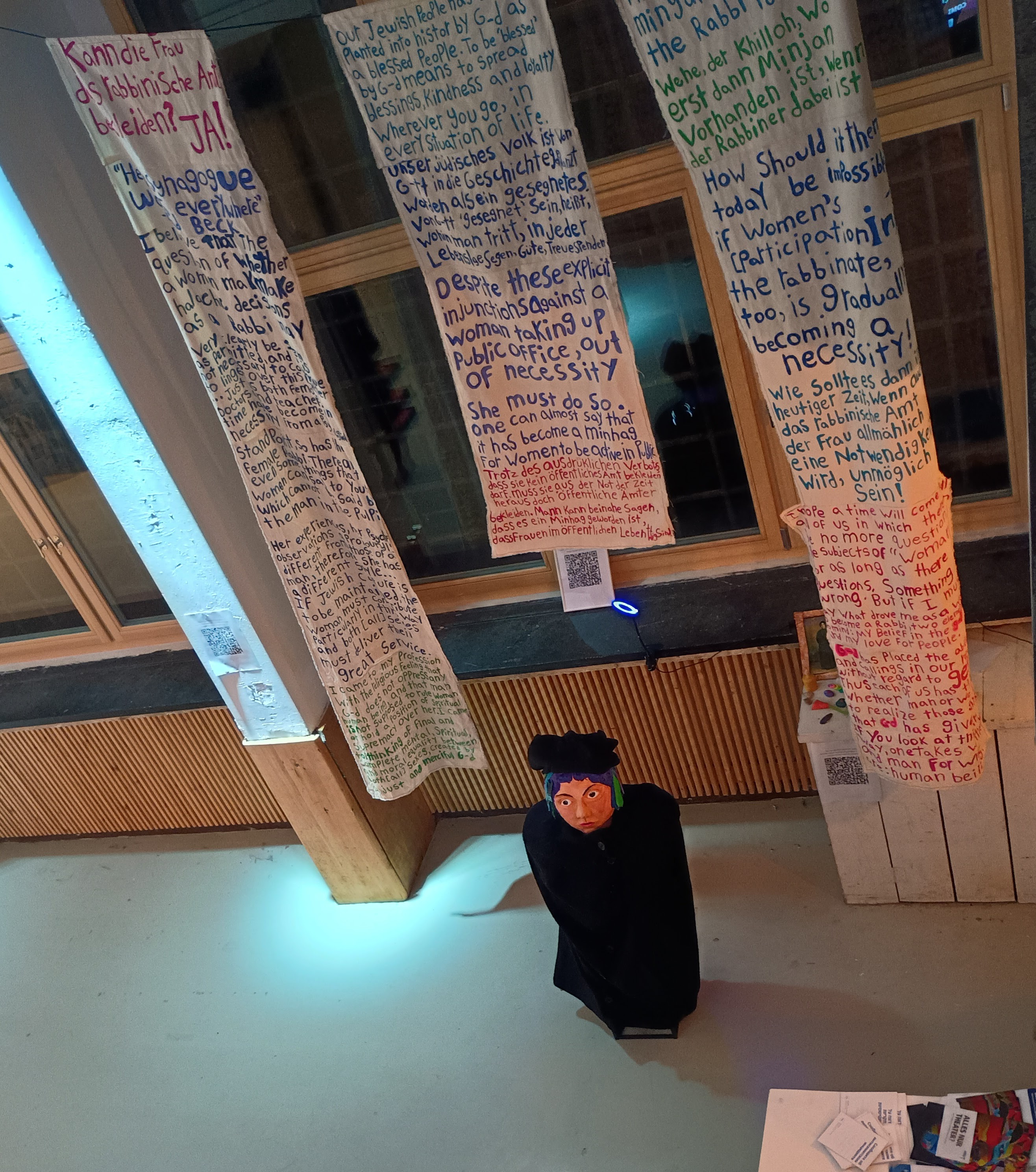
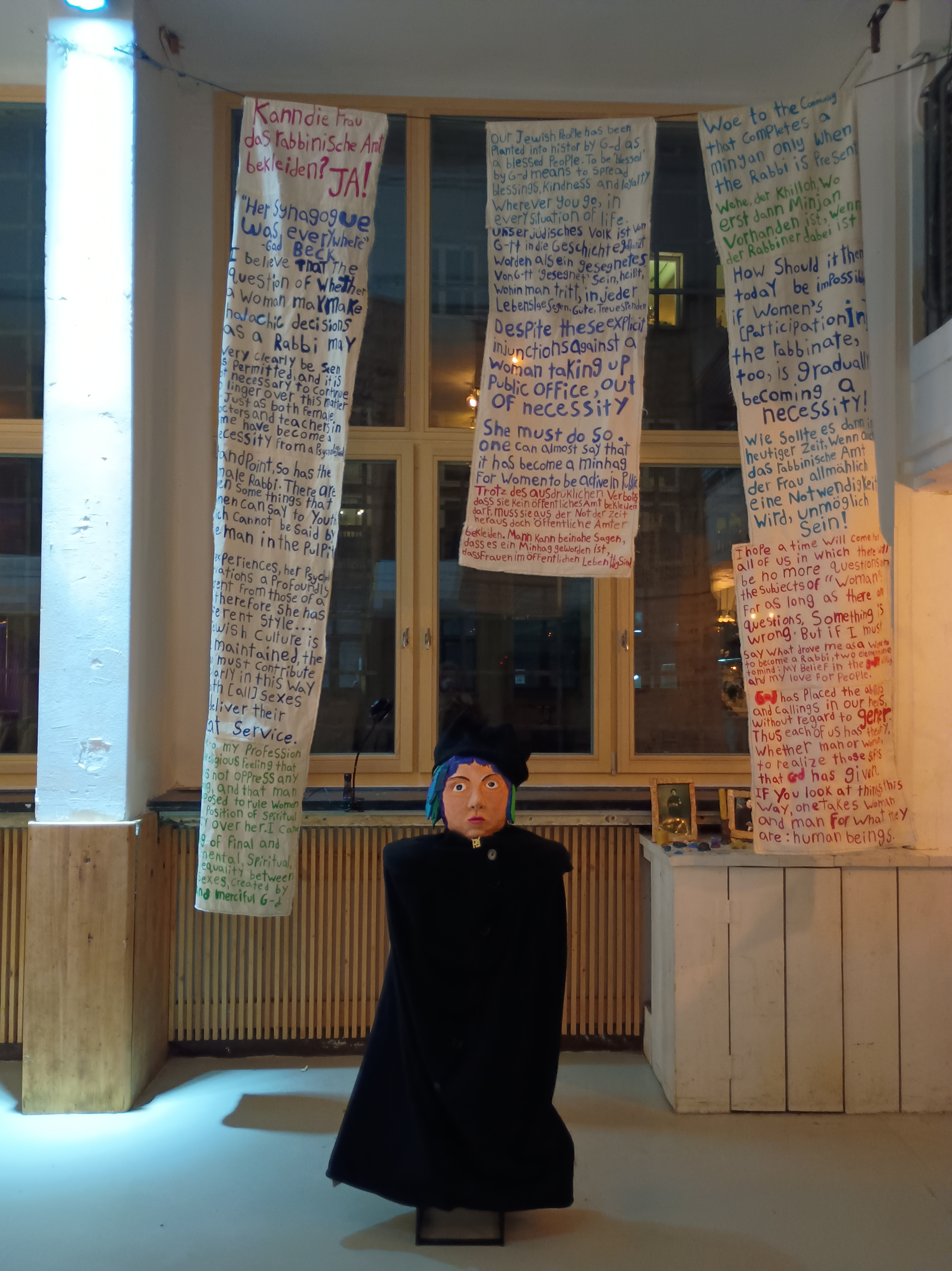
We approach the 150 cm statue of Rabbi Jonas in a large hall that is part of the building called Alte Münze that once made Reichsmark, GDR, and then Euro coins before it was turned into an arts and events space. The statue is facing the middle of the building, and directly behind it are large tall windows that have been partially obscured by three long pieces of fabric secured partway up the window frame.
The pieces of fabric have quotations from and about Rabbi Jonas. These quotes are listed in the “Quotes on Flags” section. The words are written by hand with acrylic paint and acrylic paint markers in dark blue, pink, purple, green, and light blue. The flags are finished with a zig zag stictch in rainbow and joined together on the back with a simple seam. The flags are different lengths , the one hanging right above the statues head is the shortest.
The sculpture is made of several parts. The Bust sitting on the pedestal is made from stacked and carved Recycled cardboard held together with wood glue. On top of the cardboard, the armature is pressed and molded air dry clay. On top of the clay and cardboard is acrylic paint, coloring her face a peachy tone with pink lips and brown eyes. The shapes of her face such as her nose and eyes are carved into the bust so that when one runs their finger over the face you can feel the groves and dips. The back of the sculpture has cardboard hair replicating her curls not covered in clay-colored various neon and bright colors. There are strands of cardboard hair in green, blue, purple, pink, yellow, teal, and pastels.
On her head rests a seven pointed Kappl traditionally made of all Woll. For my sculpture woll was too expensive so I bought a woll polyester blend. It is a black color, and feels fuzzy and stretches with ease.
Around the bust sits the collar of the Talar, robe made of the woll and polyester and fabric buttons, velcro, and some thread. The garmet is inspired by the rabbinical robes she would haver worn, but it is not meant to be an exact replica. It done in my style that is exaggerated and slightly clown-like with the large buttons and surrealist playfulness.
Behind the sculpture to the right is a small pop up memorial for Rabbi Jonas contianing two of her photographs in cardboard frames, alongside handpainted stones in blue with pink hearts, shells, clay offerings of a rainbow challah and an eye, unlit candles, a bag of cloves, and a print out of the mourner’s kaddish. Visitors are invited to lay more offerings on this space, so the items will grow and change placement throught the night.
The Story Behind the Sculpture
90 years ago in 1935, Rabbi Regina Jonas (1902-1944) was ordained as a Rabbi, the first woman to receive Semikhah; an influential and important figure for Jewish Feminism, progress, and inclusivity. Inspired by the medium of cardboard as something she touched every day in Zwangsarbeit (forced slave labor) at the Lichtenburg Epeco Kartonagenfabrik (cardboard factory), working alongside Gertrude Kolmar and Gad Beck I sought to transform this material from its previous form as something discarded into a tribute to Rabbi Jonas’s life, work, and spirit.
When I knew I wanted to work with cardboard for this sculpture I turned to Phranc the All-American Jewish Lesbian Folksinger aka the Cardboard Cobbler who works in songwriting (being the first lesbian to be signed to a major record label) and more recently she has been making incredible objects out of cardboard and paper and uses sewing and acrylic paint to attach things to each other. Her objects tell the story of her gender confused and gay childhood which I relate heavily to. She also grew up in Mar Vista in Los Angeles, which is where I lived as a baby during my first nine months on the planet. Phranc’s songs have gotten me through a lot of tough times, and this fall when I was relistening to her albums I googled some song and ended up finding out about her incredible oeuvre of visual art which I knew nothing about before. There is a great talk about her work that she gave in 2024 at the University of Michigan which can be viewed here: https://stamps.umich.edu/events/phranc#video
I wish I could have been in the audience!
I also relate heavily to finding magic in cardboard boxes, I made many objects out of cardboard as a child and as an adult having to move so much and needing to use what I had to store my stuff in a nice way and make art when I could not afford canvases cardboard was there for me. Seeing what Phranc was able to create out of cardboard I felt a renewed inspiration and ability to make Rabbi Jonas out of cardboard.
The other material I worked with for this project was fabric. I benefited from the research of many incredible people: Rabbi Levi Israel Ufferfilge, Paige Harouse, and Rebecca Rogowski who provided valuable research assistance and insights and I am very grateful to Rabbi Elisa Klapcheck, Dr. Sara Wobick Segev, and Dr. Katharina von Kellenbach for their illuminating scholarship on Rabbi Jonas with vital translating by Toby Axelrod. Their work helped me find quotations to write on the three fabric flags, and build garments inspired by what Rabbi Jonas wore in the photographs we have of her. I also drew inspiration from Elke Steiner’s comic on Rabbi Jonas and Marlis Glaser’s portrait of Rabbi Jonas
.
One of my favorite sewing projects in this artwork was creating the hat called a Kappl which she wears sometimes straight on or a little crooked and to the side.

The Kappl was also worn by Lilly Montagu.

Photo from the West Central London Synegouge memorial Website https://www.wclslegacy.net/
I used old photos to help me make the pattern for the hat, as no pattern (that I could find) currently exist on the internet. It was a pretty easy drafting process. I drew a seven pointed star, and then cut out 14 panels of long trapezoids. I connected these to the star base and a elastic band and then done!
I made the Robe after learning what a Talar was, and looking up some examples. I was also able to make a negative shifted version of the Rabbi Jonas portrait to understand its construction better.
After I decided that I wanted to recreate the button up look and the gathering of the folds I started on cutting the fabric to create the pattern. I cut the shoulders by draping half a meter and cutting around her head, and then made a collar by wrapping around some fabric around the neck and placing it how I felt right. It was significantly easier because I did not need to make any arms. I sewed these pieces together and was happily surprised it was to my liking. Then I cut the two pieces for the draping and sewed the top to create gathering lines. Then I added on the buttons and other finishing touches, and placed this over the sculpture and it fit perfect! I wanted to continue the theme of a more colorful and playful take on this serious black and white photograph, and the not so perfect or straight lines of seams and the oversize buttons add to this energy. In the process of building the sculpture and sewing the robes I stumbled upon the information that she actually wore purple not black robes. I love this fact, and am sad that I did not learn this in time before I made the robe, so I will have to do it again in purple if I find the right fabric.
I created the pop up memorial for her in the corner because I wanted a place for people to engage with her memory beyond just reading the quotes or looking at the sculpture. For me having somewhere to place a stone to honor someone’s memory is a really important part of memorials, especially to honor those who do not have gravestones. In this way I am envoking the concept of a Shoah memorial and Erinnerungskultur into a space that was run for a long period of time by fascists creating money that was spent doing awful things to our people. It is a very weird and twisted and at times a cruel and ironic thing to be a Jew in Berlin, and interact with layers of history by just existing in a space or putting art in room where there are still echos from people embedded in the walls that did not want you alive. But my response to this uncomfortable reckoning is the explicit creation of a space that wants us, wants to hold our memories and grief, joy and anger and that is why I have this mini memorial set up.
In the process of creating this work, I learned that my great Grandmother Ruth Grossman also had the name Regina as her middle name. I think about my great-grandma Ruth a lot, as I never had the chance to meet her, and because I was building the sculpture her daughter, my Grammy Marlene Joy, the woman who first taught me how to sew, had the opportunity to share this aspect of our family story with me. This link made me feel even more proud to be Jewish and to be connected to so many incredible women in our tradition.
Rabbi Regina Jonas took up extraordinary pastoral care roles where she was needed most in “unlikely” places like the Jewish school, the Jewish hospital in Wedding, the cardboard factory in Lichtenberg, and in Theresienstadt. She worked with Victor Frankel on suicide prevention, and wrote important halachic feminist arguments for why women not only can but should be rabbis. Rabbi Jonas’s legacy and breakthroughs created the paths foraging equity, respect and dignity in Jewish spaces for teachers and spiritual leaders of marginalized genders. The first out transgender rabbi in our tradition, Rabbi Elliot Kukla, was ordained in 2006, less than 20 years ago. There is still so much work to be done, and honoring those who came before us and paved the way to where we are now is an imporant part of creating a better and more welcoming world for future Rabbis, Clergy, students, and jewish community members of all genders!
Quotes on Flags, description, and list of quotes
First flag – furthest left, longest
Title of the work, inspired by Rabbi Jonnas’s thesis:
Kann die Frau das rabbinische Amt bekleiden? Ja!
Quote from Gad Beck:
“Her synagogue was everywhere”- Gad beck
The rest of the words written on the flags are quotes and translations by Rabbi Regina Jonas herself.
“I believe that the question of whether a woman may make halachic decisions as a Rabbinerin may very clearly be seen as permitted, and it is not necessary to continue to linger over this matter . . . Just as both female doctors and teachers in time have become a necessity from a psychological standpoint, so has the female rabbi. There are even some things that women can say to youth, which cannot be said by the man in the pulpit. Her experiences, her psychological observations are profoundly different from those of a man, therefore she has a different style . . . If Jewish culture is to be maintained, the woman must contribute particularly in this way and both sexes must deliver their great service.”
“I came to my profession with the religious feeling that G-d does not oppress any human being, and that man is not supposed to rule woman or hold a position of spiritual supremacy over her. I came to it thinking of final and complete mental, spiritual and moral equality between both sexes, created by a just and merciful G-d. “
Second Flag- middle, shortest
“Our Jewish people has been planted into history by G-d as a blessed people. To be ‘blessed’ by G-d means to spread blessings, kindness and loyalty wherever you go, in every situation of life.”
“Unser jüdisches Volk ist von G–tt in die Geschichte gepflanzt worden als ein gesegnetes. Von G-tt ‚gesegnet‘ sein, heißt, wohin man tritt, in jeder Lebenslage Segen, Güte, Treue spenden.”
“Despite these explicit injunctions against a woman taking up public office,
out of necessity she must do so. One can almost say that it has become a minhag
[custom] for women to be active in public.”
“Trotz des ausdrücklichen Verbotes, dass sie kein öffentliches Amt bekleiden darf, muss sie aus der Not der Zeit heraus doch öffentliche Ämter bekleiden. Man kann beinahe sagen, dass es ein Minhag geworden ist dass Frauen im öffentlichen Leben tätig sind.”
Third flag- furthest right
“Woe to the community that completes a minyan only when the rabbi is present”
“Wehe, der Khilloh, wo erst dann Minjan
vorhanden ist, wenn der Rabbiner dabei ist”
“How should it then today be impossible, if women’s [participation in] the rabbinate,
too, is gradually becoming a necessity!”
“Wie sollte es dann in heutiger Zeit, wenn auch das rabbinische Amt der Frau allmählich eine Notwendigkeit wird, unmöglich sein!”
“I hope a time will come for all of us in which there will be no more questions on the subjects of “woman”: for as long as there are questions, something is wrong. But if I must say what drove me as a women to become a rabbi, two elements come to mind: My Belief in the g-dly calling and my love for people. G-d has placed abilities and callings in our hearts, without regard to gender. Thus each of us has the duty, whether man or woman, to realize those gifts G-d has given.
If you look at things this way, one takes woman and man for what they are: human beings.”
More writings by Rabbi Jonas can be found here: https://jwa.org/blog/excerpts-from-writings-of-regina-jonas
Materials List (detailed)
Bust
Recycled Cardboard
Air Dry Clay
Wood Glue
Acrylic Paint
Kappl (hat) and Talar (cassock/preaching gown)
Woll and polyester fabric blend
Plastic buttons
Velcro
Thread
Quotations Flags
Canvas Fabric
Acrylic Markers
Acrylic Paint
Yarn
Thread
Pop up Memorial
Stones from Berlin
Stones from Los Angeles
Acrylic Paint
Cardboard
Printed Photographs
Clay offerings
Unlit Candles
Exhibition Text/ Short Description
EN:
90 years ago in 1935, Rabbi Regina Jonas (1902-1944) became the first woman to receive Semikhah. Inspired by the medium of cardboard as something she touched every day in Zwangsarbeit at the Lichtenburg Epeco Kartonagenfabrik, I transformed this material from its previous form as something discarded without much thought into a tribute to Rabbi Jonas’s life, work, and spirit. Many thanks to Rabbi Levi Israel Ufferfilge, Paige Harouse, and Rebecca Rogowski who provided valuable research assistance and insights and I am very grateful to Rabbi Elisa Klapcheck, Dr. Sara Wobick Segev, and Dr. Katharina von Kellenbach for their illuminating scholarship on Rabbi Jonas.
DE:
Vor 90 Jahren, im Jahr 1935, wurde Regina Jonas (1902-1944) war die erste Frau, die die Semikhah erhielt. Inspiriert durch das Medium Pappe, mit dem Rabbinerin Regina Jonas während der Zwangsarbeit in der Lichtenburger Epeco Kartonagenfabrik täglich in Berührung kam, habe ich versucht, dieses Material von seiner früheren Form als etwas, das ohne viel Nachdenken weggeworfen wurde, in eine Hommage an das Leben, die Arbeit und den Geist von Rabbinerin Jonas zu verwandeln. Vielen Dank an Rabbiner Levi Israel Ufferfilge, Paige Harouse und Rebecca Rogowski, die mir bei meinen Recherchen wertvolle Hilfe leisteten und ebenfalls bin ich Rabbinerin Elisa Klapcheck, Dr. Sara Wobick Segev und Dr. Katharina von Kellenbach sehr dankbar für ihre wegweisenden wissenschaftlichen Arbeiten über Rabbinerin Regina Jonas.
Works cited
This artwork would not have been possible in its current version if not for the information and details provided in the various books, articles, talks, and comics that informed my sketches, fabrication, and final refining of the sculpture. I am so grateful for all of the scholars, artists, rabbis and feminists who wrote about researched and celebrated Rabbi Jonas. Thank you.
Adler, Sharon. “Habitus: A Diaspora Journal. Die Berlin-Ausgabe Mit Einem Comic von Elke
Steiner Zur Rabbinerin Regina Jonas Aviva – Berlin Online Magazin Und Informationsportal Für Frauen Aviva-Berlin.de Literatur.” AVIVA, 14 Mar. 2011, www.aviva-berlin.de/aviva/content_Literatur.php?id=1430096.
Apple, Raymond. “Oztorah.” OzTorah ” Blog Archive ” Robes & the Rabbis, oztorah.com/2012/03/robes-the-rabbis/.
Appell, Rabbi Victor S. “Why Do Some Jews Write ‘G-D’ Instead of ‘God’?” Reform Judaism,reformjudaism.org/learning/answers-jewish-questions/why-do-some-jews-write-g-d-instead-god..
Axelrod, Toby. “My Year in Berlin with Regina Jonas.” Lilith Magazine, 12 Feb. 2014, lilith.org/articles/my-year-in-berlin-with-regina-jonas/.
Barron , Melody. “The Story of Regina Jonas, the First Female Rabbi/רגינה יונאס – סיפורה של הרבה הראשונ.” The Librarians, 9 Nov. 2017, blog.nli.org.il/en/rabbi_regina_jonas/.
Gutknecht, Christoph. “Gott Oder g’tt.” Jüdische Allgemeine, Jüdische Allgemeine, 7 Oct. 2013, www.juedische-allgemeine.de/religion/gott-oder-gtt/.
Herweg, Rachel Monika. “Regina Jonas (1902–1944).” In Meinetwegen ist die Welt erschaffen. Das intellektuelle Vermächtnis des deutschsprachigen Judentums. 58 Porträts, edited by Hans Erler, Ernst Ludwig Ehrlich, and Ludger Heid. Frankfurt, New York: 1997.
Jewish Magazine. The “Kappel” and the “Kippa,” www.jewishmag.com/110mag/kippa/kippa.htm.
“Jewish Practices & Rituals.” Rabbinic Ordination (Semikha), www.jewishvirtuallibrary.org/rabbinic-ordination-semikha.
Jewish Women’s Archive. “2017 Portrait of Regina Jonas by Marlis Glaser.” <https://jwa.org/media/2017-portrait-of-regina-jonas-by-marlis-glaser>.
Jewish Women’s Archive. “About the Project.” www.jwa.org/rabbis/about
Jewish Women’s Archive. “Memorial Ritual for Regina Jonas.” Ritualwell, ritualwell.org/ritual/memorial-ritual-regina-jonas/.
Jewish Women’s Archive. “Short Film: In the Footsteps of Regina Jonas.” <https://jwa.org/rabbis/regina-jonas-remembered/film>.
Kellenbach, Katharina von. “Preaching Hope: Denial and Defiance of Genocidal Reality in Rabbi Regina Jonas’ Work.” In shofar (1998).
Kellenbach, Katharina von. ““God Does Not Oppress Any Human Being” The Life and Thought of Rabbi Regina Jonas.” The Leo Baeck Institute Year Book 39, no. 1 (1994): 213-225.
Kellenbach, Katharina von. “Forgotten Voices: German Women’s Ordination and the Holocaust.” In Proceedings of the Second Biennial Conference on Christianity and the Holocaust, Rider College II (1992).
Klapheck, Elisa, ed. Fräulein Rabbiner Jonas—The Story of the First Woman Rabbi. San Francisco: 2004. (Fräulein Rabbiner Jonas—Kann die Frau das rabbinische Amt bekleiden? Teetz: 2000)
Klapheck, Elisa. Regina Jonas – The First Woman Rabbi, YouTube, Leo Beck Institute London. www.youtube.com/watch?v=hWbyPowcn6w
Klapheck, Elisa. “Regina Jonas.” Shalvi/Hyman Encyclopedia of Jewish Women. 27 February 2009. Jewish Women’s Archive.<https://jwa.org/encyclopedia/article/jonas-regina>
Klapheck, Elisa. “Regina Jonas’ Streitschrift.” Bet Debora Berlin, hagalil Online, www.hagalil.com/bet-debora/journal/klapheck.htm.
Lölhöffel, Helmut, and Charlotte Kreutzmüller. “Gertrud Kolmar (Künstlername) Née Chodziesner.” Gertrud Kolmar (Künstlername) Née Chodziesner | Stolpersteine in Berlin, www.stolpersteine-berlin.de/en/munchener-str/18/gertrud-kolmar-kunstlername.
Moore, Deborah Dash. “Saving Regina Jonas.” Frankely Speaking, Jean & Samuel Frankel Center for Judaic Studies (December 2014): 2. https://lsa.umich.edu/content/dam/judaic-assets/judaic-newsletters/December-Final.pdf
Phranc. “All Things Phranc.” Phranc, http://www.phranc.la/. Accessed 22 Jan. 2025.
Priesand, Rabbi Sally J. “Remembering Rabbi Regina Jonas.” Jewish Women’s Archive, jwa.org/rabbis/regina-jonas-remembered/remembering-rabbi-regina-jonas
Richmond, Abby. “Painting Courage and Painting History.” 18 January 2018. Jewish Women’s Archive. https://jwa.org/blog/painting-courage-and-painting-history
“Regina Jonas.” Leo Baeck Institute, 22 Apr. 2024, libraryoflostbooks.com/reading-room/regina-jonas/.
Reimer, Gail. “Connecting across the Divide.” Jewish Women’s Archive, jwa.org/rabbis/regina-jonas-remembered/connecting-across-divide.
Reimer, Gail and Julie Mallozzi, dir. In the Footsteps of Regina Jonas. 2014.
Rürup, Miriam. “Jewish Life in Germany before 1945 Weimar Republic (1919-1933).” Bpb.De, Bundeszentrale für politische Bildung, 12 Feburary 2022, www.bpb.de/shop/zeitschriften/izpb/juedisches-leben/504519/weimarer-republik-1919-1933/.
Sarah, Elizabeth. “The Discovery of Fräulein Rabbiner Regina Jonas: Making Sense of Our Inheritance.” European Judaism: A Journal for the New Europe 28, no. 2 (1995): 91-98.
Schäfer, Jacqueline. “Die Wegbereiterinnen: Lily Montagu Und Regina Jonas – Vrds – Verband Der Redenschreiber Deutscher Sprache.” VRdS, 4 Jan. 2023, vrds.de/die-wegbereiterinnen-lily-montagu-und-regina-jonas/.
“Silk and Wool Kapotas.” Kapotas NY, kapotasny.com/
Silverman, Emily Leah. Edith Stein and Regina Jonas: Religious visionaries in the time of the Death Camps. Routledge, 2014.
Sinclair, Stefanie. “Regina Jonas: forgetting and remembering the first female rabbi.” Religion 43, no. 4 (2013): 541-563.
Sinclair, Stefanie. “Memory and identity: Female leadership and the legacy of Rabbi Regina Jonas.” (2019).
Steiner, Elke R. Regina Jonas – Electrocomics, electrocomics.de/pdfs/electrocomics_regina_jonas.pdf. Accessed 22 Jan. 2025.
Tabick, Jackie. “Lily’s Legacy | Liberal Judaism.” Education Hub Week 2: Lily Montagu by Rabbi Dr Jackie Tabick, The Montagu Centre, 10 Feb. 2020, www.liberaljudaism.org/category/lilys-legacy/.
Wobick-Segev, S. (2023). The text and context of Regina Jonas’s Halakhic work ‘Kann die Frau das rabbinische Amt bekleiden?’ Journal of Modern Jewish Studies, 23(2), 305–326. https://doi.org/10.1080/14725886.2023.2208526
Zeveloff, Naomi ,“For Elliot Kukla, Gender Transition and Ordination Went Hand in Hand.” The Forward, 15 July 2013, forward.com/news/180226/for-elliot-kukla-gender-transition-and-ordination/.
 Mycelium Memory